How to solve connect-the-dots puzzles
Connect each pair of same-coloured dots with a line, and never let two lines cross. To solve hard boards, start where there is the least room: dots on edges and corners, dots with only one free neighbour, and narrow corridors that only one line can use. Decide who owns each tight space first, then route the open pairs last.
Why we can tell you this
We make PIXEL LINKS, a connect-the-dots puzzle game for Android. Our levels are generated by a program and then checked by a solver that proves every board can be solved. The solver also helps us score how hard a board is: how many pairs it has, how long their lines are, how many cells sit in narrow corridors, and how often the solver has to back up and try another route. This guide turns that experience into techniques you can use on any puzzle of this kind, ours or not.
The rules in one line
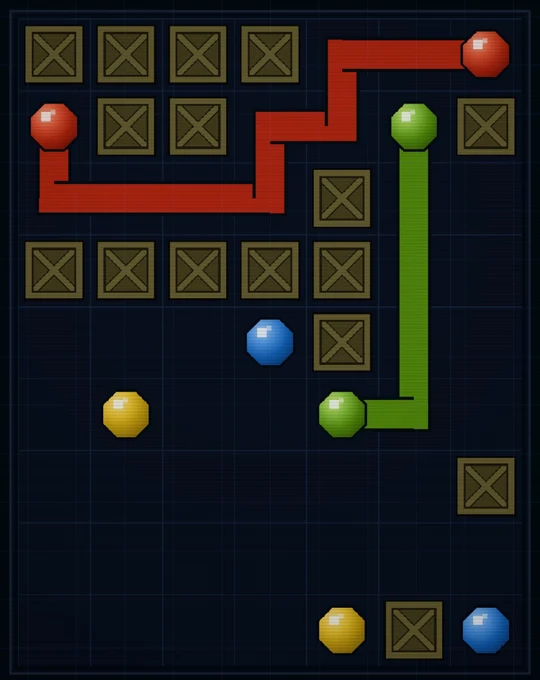
Draw a line from each dot to its partner. Lines can't cross or overlap, and they can't go through walls: in PIXEL LINKS the walls are wooden crates, and dragging into one pops your own line. If your line touches another pair's line or dot, your line pops, and theirs too if it's drawn.
1. Start at the edges and corners
A dot on the edge of the board has fewer ways out than a dot in the middle; a dot in a corner has only two. Fewer choices means fewer mistakes, so draw those first.
2. Take the forced moves
Look for a dot with only one free cell next to it. Its line has to start that way, no thinking needed. Each forced move you draw removes space from the board and often creates the next forced move. Good boards are built from chains like this.
3. Find the bottleneck and decide who owns it
A corridor one cell wide can carry only one line. When two pairs both seem to need it, one of them is wrong. Ask which pair has no other way round; that pair owns the corridor, and the other pair must go the long way. Many of our boards are built on crate patterns (rooms, narrow corridors, zigzags) that are placed before the lines are laid, so the lines have to work around them.
4. Don't trust the obvious shortcut
Some boards offer a short, straight route that looks perfect and blocks another pair completely. Boards like this make our solver back up and try again more often, and that counts toward a level's difficulty. If a pair is very close together but the board still feels hard, suspect the short route first.
5. Think about order, not just routes
Sometimes a pair can only be drawn once another pair has claimed its space. If you keep popping the same two lines, stop drawing and ask: which of these has fewer options? Draw that one first.
6. You don't have to fill every square
In some connect-the-dots games every cell must be covered. In PIXEL LINKS it doesn't have to be: a level clears when every pair is connected, and empty cells are fine. So don't stretch a line just to fill space; the shortest line that leaves room for the others is usually right.
7. Use undo and restart as tools
A popped line is information: it tells you two pairs want the same space. In PIXEL LINKS you get 3 undos per attempt, and restarting the level or coming back to it gives them back. If you're truly stuck, HINT draws one correct pair for you. The first Full Hint on every level is free; after that, another one costs a short ad you choose to watch, when one is available. Remove Ads owners get one more free Full Hint every five minutes instead.
Practise on three real levels
Try three PIXEL LINKS levels in your browser, no install and no sign-up: play the demo.
Want more? PIXEL LINKS has 160 levels in 8 chapters, a new daily board every day, and a 1,000-board run. It's free on Google Play with ads (how they work), plays offline, and never rushes you: no time limits, no lives.
Questions
Is there always only one solution?
Not always. Empty cells are allowed, so many boards have more than one route. Our solver checks whether a board has exactly one solution, and for the harder spots in each chapter we prefer boards that do.
What's the name of this kind of puzzle?
It's often called Numberlink, a flow puzzle, or connect-the-dots. The rules vary slightly between games, for example whether every square must be filled.